


How to Join Indian Army After 12th: Many young Indians dream of wearing the uniform and serving the nation. Joining the Indian Army offers not just a stable career but a life defined by discipline, purpose, and pride. Whether you have completed Class 10, 12, or hold a graduation degree, multiple entry routes exist to turn this aspiration into reality.
For more updates join in our whatsapp channel
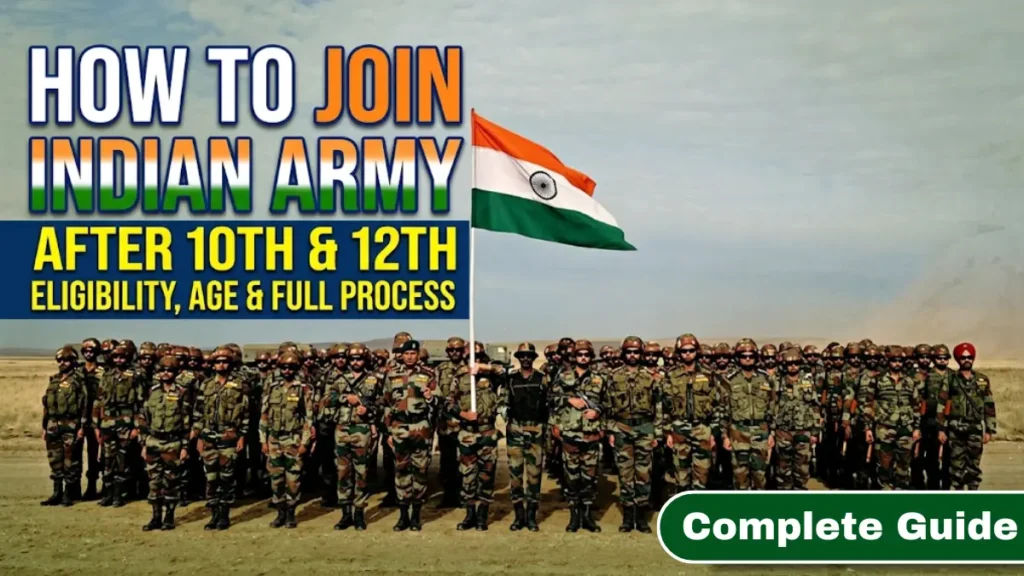
This guide covers everything from soldier-level positions under the Agnipath scheme to officer entries through prestigious exams like NDA and CDS. The paths demand physical and mental toughness, but they reward those ready to commit.
How to Join Indian Army After 10th
Completing Class 10 opens doors to various soldier-level roles in the Indian Army. These positions focus on ground duties, technical trades, and support roles.
Here is a summary of key entry options:
| Entry Role | Main Duties | Educational Eligibility | Age Limit (approx.) | Additional Requirements |
|---|---|---|---|---|
| Agniveer (General Duty) | Patrolling, combat, guarding | Class 10 with min. 45% aggregate & 33% per subject | 17.5 – 21/22 years | Physical fitness standards |
| Agniveer (Tradesman) | Technical trades (electrician, fitter, etc.) | Class 10 + relevant ITI certificate | 17.5 – 23 years | ITI certificate in specific trade |
| Soldier (Clerk/Storekeeper) | Administrative and logistics support | Class 10 with typing/computer skills | 17.5 – 23 years | Typing speed and basic computer knowledge |
| Agniveer (Tradesman – 8th/10th) | Support roles (chef, housekeeper, etc.) | Class 8 or 10 | 17.5 – 21/22 years | None specific beyond education |
Note: Under the Agnipath scheme, selected Agniveers serve for four years, with up to 25% potentially moving to permanent roles. Always verify the latest notification on joinindianarmy.nic.in, as age relaxations (up to 22 years) appeared in some 2026 intakes.
Selection Process for Soldier Entries After 10th
The recruitment follows a structured, multi-stage process:
- Online Registration – Apply through the official Indian Army portal when notifications are released.
- Physical Fitness Test (PFT) – Includes running (e.g., 1.6 km in specified time), pull-ups, push-ups, and long jump.
- Medical Examination – Thorough health check to meet Army standards.
- Common Entrance Exam (CEE) – Tests general knowledge, reasoning, and basic mathematics.
- Document Verification – Final check of certificates and credentials.
Physical preparation is crucial. Regular running, strength training, and a disciplined routine improve success chances.
How to Join Indian Army After 12th
After Class 12, candidates can aim for both officer and soldier positions. Two major officer-level routes stand out: National Defence Academy (NDA) and Technical Entry Scheme (TES).
Key Options After 12th:
- NDA Entry (Army, Navy, Air Force): Conducted by UPSC. Requires 10+2 (any stream for Army; PCM for technical wings). Age: 16.5-19.5 years. Involves written exam, SSB interview, and medical test. Open to both men and women.
- Technical Entry Scheme (TES): For PCM students with minimum 60% marks. Direct technical officer entry with SSB and medical stages. Age: 16.5-19.5 years (male only in many cases).
- Agniveer/Soldier Entries: Various trades based on 10+2 marks and specific subjects.
NDA remains one of the most sought-after paths for a full career as a commissioned officer.
How to Join Indian Army After Graduation
Graduates have excellent opportunities to join as officers through several entries.

Major Graduate-Level Entries:
- Combined Defence Services (CDS) Exam: For Indian Military Academy (IMA) and Officers Training Academy (OTA). Age limits vary (19-24/25 years). Graduation from a recognized university required. Includes written exam, SSB, and medical.
- Short Service Commission (SSC) Tech: For engineering graduates. Age: 20-27 years (men), 19-25 (women). Shortlisting based on academics followed by SSB.
- NCC Special Entry: For NCC ‘C’ certificate holders with graduation (min. 50%). Age: 19-25 years.
- Technical Graduate Course (TGC) and University Entry Scheme (UES): Targeted at engineering students and graduates.
Territorial Army offers a part-time option for graduates who wish to serve while continuing civilian careers.
Steps on How to Apply for Indian Army
- Decide Your Stream – Match your education (technical, non-technical, medical) with available entries.
- Monitor Notifications – Regularly check joinindianarmy.nic.in and upsc.gov.in.
- Prepare Physically and Mentally – Build stamina and practice for written exams or SSB interviews.
- Submit Online Application – Fill forms carefully with accurate details and documents.
- Prepare for Tests – Written exams, physical tests, SSB (psychological, group tasks, interview), and medical examination.
- Final Merit and Training – Selected candidates join respective training academies like NDA, IMA, or others.
Staying updated and maintaining consistency in preparation are key.
How to Join Indian Army for Females After 12th
Women now have expanded opportunities. The NDA exam is open to female candidates. Other routes include SSC Non-Technical, Military Nursing Service, and specific Agniveer roles (like Women Military Police).
Eligibility Highlights for Women:
- Age: 16.5–19.5 years for NDA.
- Qualification: 10+2 from a recognized board.
- Must meet physical and medical standards.
The selection process mirrors that for male candidates: written exam, SSB, and medical tests.
Summing Up
Joining the Indian Army is a commitment to service, discipline, and national pride. From Agniveer roles after 10th to officer positions via NDA, CDS, or technical entries after higher education, structured paths exist for dedicated aspirants. Success requires early preparation, physical fitness, academic focus, and resilience.
Check official websites for the latest notifications, as dates, vacancies, and minor criteria can change. With determination, your dream of serving in olive green is achievable.
Financial Disclaimer: This article is for informational purposes only. Salary, benefits, and service conditions are subject to government rules and may vary. Consult official sources for accurate details on pay and perks.
